
Last Updated: July 2026 · Domlust Design & Testing Team · Reading time: 8 minutes
The Short Answer
Most strap-on harnesses are painful because they are made from materials that were never designed for sustained skin contact under physical stress — PVC, nylon, and rough canvas that chafe, dig, and shift. The discomfort is not a user problem. It is a design and material problem. This guide explains exactly what causes it and what actually fixes it.
Why Most Strap-On Harnesses Cause Pain: The Actual Reasons
Strap-on harness design has not changed significantly in decades. The dominant format — fabric straps, metal buckles, O-ring — was developed for function, not comfort. The result is a category of products that work mechanically but fail ergonomically for a significant proportion of users.
Here are the specific failure modes, in order of how commonly they are reported:
1. Friction Burns and Chafing from Strap Material

Most harness straps are made from PVC, nylon webbing, or canvas. These materials have two properties that make them problematic for sustained skin contact under movement:
- Low surface lubricity: PVC and nylon have high friction coefficients against skin — they grip rather than slide. Under repeated thrusting motion, this grip creates friction burns on the inner thighs, hip bones, and lower abdomen.
- No thermal response: These materials do not warm to body temperature — they remain at ambient temperature throughout use. The persistent cold-material sensation against skin is a constant reminder that you are wearing equipment.
The areas most commonly affected: inner thighs where the leg straps cross, the hip bones where the waistband sits, and the lower abdomen where the front panel presses during thrusting. In extended sessions, these areas develop redness, chafing, and in more vigorous use, abrasion.
2. Pressure Points from Fixed Anchor Points
Harness straps create fixed anchor points — locations where the strap is held in place by a buckle or ring. These anchor points do not move with the body. During thrusting, the body moves but the anchor point stays fixed — creating a shear force at the contact point between strap and skin.
The most common pressure point locations: the hip bones (where the waistband buckle sits), the inner thigh (where the leg strap crosses), and the perineum (in harnesses with a crotch strap). These are bony prominences with minimal soft tissue padding — sustained pressure from a fixed strap against a bony prominence produces pain within minutes of vigorous use.
3. Dildo Slippage and Tilting Mid-Session
The O-ring design creates a pivot point — the dildo is a separate object held in place by a ring in the fabric. Under thrust pressure, the dildo exerts lateral force against the O-ring. The fabric stretches slightly, the O-ring pivots, and the dildo tilts away from perpendicular.
This is not a quality problem — it is a physics problem. Even premium harnesses cannot eliminate the pivot point created by the O-ring. The dildo is always a separate object being held in place, and separate objects under force will always find the path of least resistance.
The practical consequence: mid-session repositioning, interrupted rhythm, and the persistent cognitive overhead of monitoring whether the dildo is still in position. For users who want to be fully present in the experience, this overhead is a significant distraction.
4. Emotional Disconnect from Mechanical Design
This is the pain point that most guides do not cover — and the one that matters most for users for whom a strap-on is part of identity expression rather than just a sex toy.
A fabric harness is visibly mechanical. Buckles, straps, rings — the visual and tactile experience is of wearing equipment. For users who want the strap-on to feel like part of their body — trans men, non-binary users, lesbian Dommes in full role — the harness format creates a persistent reminder that it is not. The gear interrupts the experience rather than enabling it.
This emotional disconnect is not a psychological weakness — it is a rational response to a design that prioritizes mechanical function over embodied experience.
The Material Problem: Why PVC and Nylon Harnesses Cannot Be Fixed
The discomfort problems above are not fixable by improving the harness design within the same material category. They are inherent to the material properties of PVC, nylon, and canvas:
| Material | Friction Against Skin | Thermal Response | Flexibility Under Movement | Skin Safety (Extended Contact) |
|---|---|---|---|---|
| PVC | ❌ High — grips skin, causes friction burns | ❌ None — stays at ambient temperature | ❌ Rigid — creates fixed pressure points | ⚠️ Contains plasticizers that migrate to skin surface |
| Nylon webbing | ❌ High — abrasive texture against skin | ❌ None | ⚠️ Flexible but does not conform to body curves | ✅ Generally inert — no plasticizer migration |
| Canvas | ❌ Very high — rough texture causes chafing rapidly | ❌ None | ❌ Stiff — minimal body conformity | ✅ Generally inert |
| Leather | ✅ Lower than synthetic — softer against skin | ⚠️ Slow thermal response | ✅ Conforms to body over time | ✅ Generally safe — but requires maintenance |
| Platinum silicone | ✅ Minimal — smooth, low friction against skin | ✅ Rapid — warms to body temperature within minutes | ✅ Full elastic conformity — moves with body | ✅ Non-porous, no plasticizers, chemically inert |
Leather harnesses are a meaningful improvement over synthetic materials — lower friction, better thermal response, body conformity over time. But leather harnesses still have the O-ring pivot point problem, still require buckle adjustment, and still present as visible equipment rather than as part of the body.
The material that actually solves all four pain points simultaneously is platinum silicone — but platinum silicone cannot be used in a traditional harness format. It requires a fundamentally different design approach.
The Design Solution: Why Integrated Platinum Silicone Changes Everything
The solution to strap-on discomfort is not a better harness. It is a different design paradigm: eliminate the harness entirely and integrate the dildo into a wearable platinum silicone garment.

How Integrated Dildo Pants Solve Each Pain Point
| Pain Point | Traditional Harness | Platinum Silicone Dildo Pants |
|---|---|---|
| Friction burns / chafing | ❌ PVC/nylon straps against skin — friction under movement | ✅ Platinum silicone against skin — low friction, smooth surface, no abrasion |
| Pressure points | ❌ Fixed buckle anchor points against bony prominences | ✅ No buckles, no fixed anchor points — pressure distributed evenly across elastic band |
| Dildo slippage | ❌ O-ring pivot point — dildo tilts under thrust pressure | ✅ No O-ring — dildo is part of the garment, cannot pivot or slip |
| Thermal discomfort | ❌ Ambient temperature material — persistent cold-equipment sensation | ✅ Warms to body temperature within minutes — feels like skin, not equipment |
| Emotional disconnect | ❌ Visible buckles, straps, rings — clearly equipment being worn | ✅ Looks like underwear, feels like skin — no visible hardware |
| Adjustment mid-session | ❌ Buckles loosen, dildo tilts — requires repositioning | ✅ Elastic band maintains fit — no adjustment needed during use |
The Engineering: Why the Integrated Design Cannot Slip
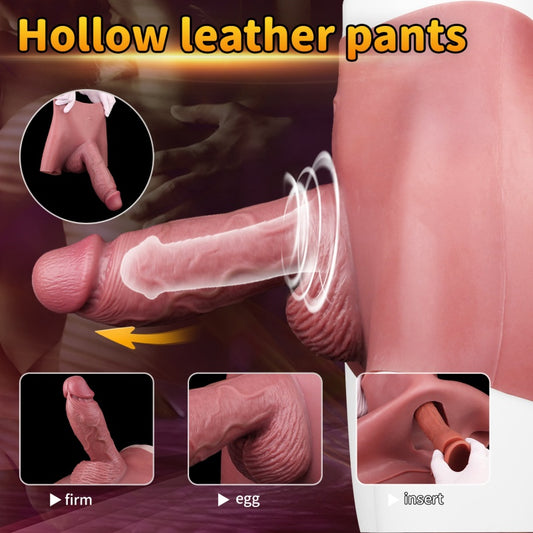
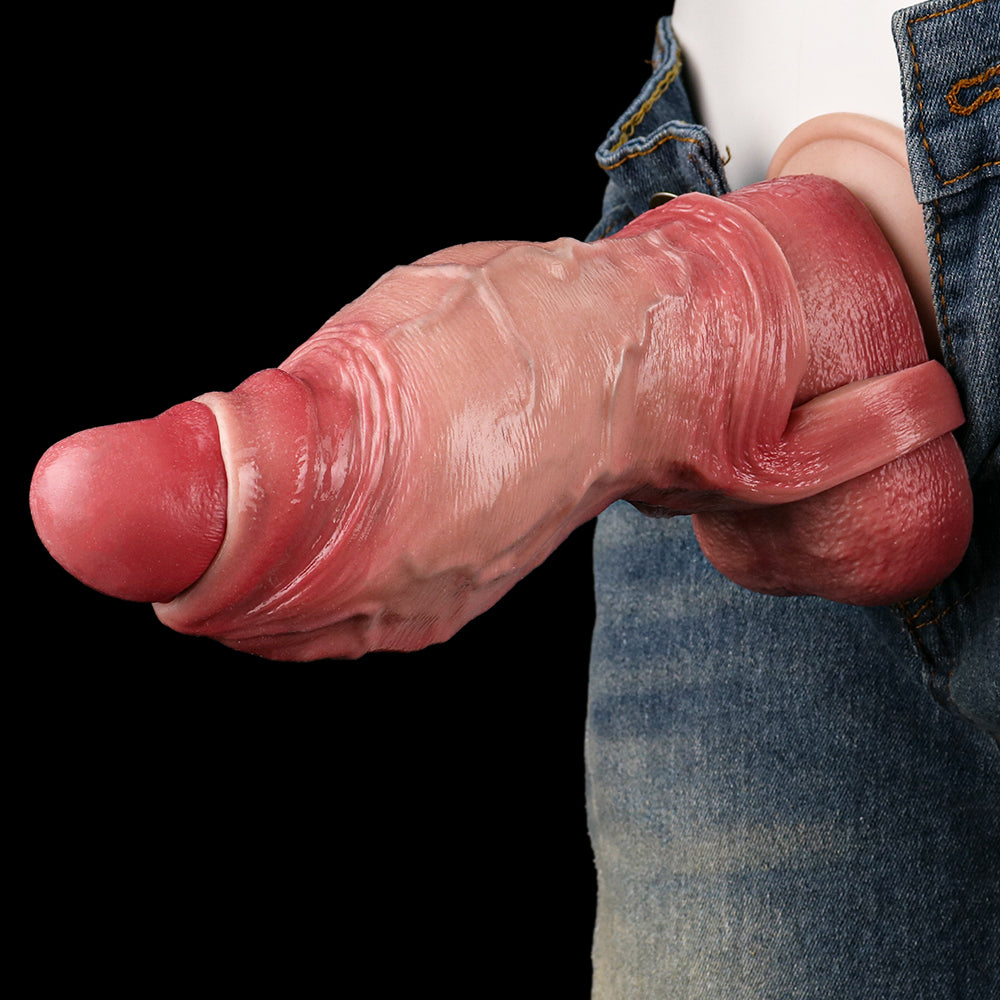
Domlust's platinum silicone dildo pants are cast as a single continuous structure — the underwear band and the dildo are the same piece of platinum silicone, produced in a single mold. The dildo is not attached to the band. It is not inserted through a ring in the band. It is physically continuous with the band — the same material, the same casting, no seam or joint between them.
When the wearing partner thrusts, the force is distributed across the entire silicone band rather than concentrated at an O-ring. The dildo moves exactly as the hips move — because it is structurally part of the same structure as the hips. There is no pivot point. There is no separate object to slip. The dildo stays exactly where it is positioned under any thrust pressure at any size.
The Elastic Memory Advantage
Platinum silicone has permanent elastic memory — it stretches under movement and returns to its original shape. The band accommodates thrusting, position changes, and body movement without losing its fit. Between sessions, it returns to its original dimensions.
This is the property that makes platinum silicone uniquely suited for wearable dildo designs. TPE — the material used in most non-silicone wearable toys — develops permanent deformation after repeated stretching. The band permanently widens, the fit degrades, and the toy no longer stays in position. Platinum silicone's elastic memory is permanent — the fit on use 200 is identical to use 1.

Integrated · Platinum Silicone · Zero Slippage · No Buckles · Ejaculating Option
Ejaculating Dildo Pants — Platinum Silicone, Integrated, Zero Slippage
One-piece platinum silicone · No buckles, no straps, no O-ring · Warms to body temperature · Elastic fit · Zero slippage at any size · Ejaculating function available · Pegging · Lesbian couples · Identity affirmation
View Product →If You Are Using a Traditional Harness: How to Reduce Discomfort
Not everyone is ready to switch formats. If you are using a traditional harness, these adjustments reduce (but do not eliminate) the discomfort problems:
- Choose leather over synthetic: Leather has lower friction against skin than PVC or nylon, conforms to body shape over time, and does not contain plasticizers. It is the best material option within the traditional harness format.
- Apply a barrier between strap and skin: A thin layer of body-safe lubricant or a fabric liner between the strap and skin reduces friction significantly. Reapply during extended sessions.
- Adjust fit before the session, not during: A harness that requires mid-session adjustment was not fitted correctly. Spend time fitting the harness before use — it should be snug but not tight, with no strap crossing a bony prominence directly.
- Use a wider waistband: Wider straps distribute pressure over a larger surface area, reducing the pressure per square centimeter at any given point. Narrow straps concentrate pressure — avoid them.
- Choose a smaller dildo for vigorous use: Heavier dildos amplify the O-ring pivot problem. If slippage is an issue, use a lighter, smaller dildo for vigorous sessions and reserve larger sizes for slower, more controlled use.
- Apply cornstarch or toy powder after cleaning: If your harness has a fabric component that contacts skin, lightly powdering the contact surface reduces friction.
The honest caveat: These adjustments reduce discomfort — they do not eliminate the fundamental design limitations of the harness format. The O-ring pivot point, the fixed anchor points, and the thermal disconnect are inherent to the design. If these are your primary pain points, the solution is a format change, not a harness adjustment.
FAQ: Strap-On Discomfort and Solutions
Why does my strap-on harness hurt?
Strap-on harness discomfort has three primary causes: friction from PVC or nylon straps against skin during thrusting, pressure points from fixed buckle anchor points against bony prominences (hip bones, inner thighs), and the thermal disconnect of ambient-temperature materials against skin. These are material and design problems, not user problems. They are inherent to the traditional harness format and cannot be fully eliminated by adjusting fit or choosing a higher-quality harness within the same design paradigm.
How do I stop my strap-on from chafing?
To reduce chafing: switch from PVC or nylon straps to leather (lower friction, better skin conformity), apply a body-safe lubricant or fabric liner between strap and skin, ensure the harness is fitted correctly before the session (no strap crossing a bony prominence directly), and use a wider waistband to distribute pressure. For complete elimination of chafing: switch to platinum silicone dildo pants, which have no straps and no fixed anchor points — the silicone band against skin has minimal friction and warms to body temperature.
Why does my strap-on dildo keep slipping or tilting?
Slippage and tilting in harness strap-ons is caused by the O-ring pivot point — the dildo is a separate object held in place by a ring in the fabric. Under thrust pressure, the dildo exerts lateral force against the O-ring, the fabric stretches, and the dildo tilts. This is a physics problem inherent to the separate-object-in-O-ring design. The solution is platinum silicone dildo pants, where the dildo is integrated into the garment as a single continuous structure with no O-ring and no pivot point.
What is the most comfortable strap-on harness material?
Within the traditional harness format: leather is the most comfortable material — lower friction than synthetic materials, conforms to body shape over time, and does not contain plasticizers. Outside the traditional harness format: platinum silicone integrated dildo pants are categorically more comfortable than any harness material — no straps, no buckles, no fixed anchor points, and the silicone warms to body temperature within minutes of skin contact.
Are dildo pants better than a strap-on harness?
For comfort: yes, categorically. Platinum silicone dildo pants eliminate every source of harness discomfort — no straps, no buckles, no O-ring pivot point, no thermal disconnect. For size selection: harnesses are better — any flat-base dildo works with a standard O-ring harness. For identity affirmation and vigorous use: dildo pants are better — the integrated design feels like part of the body rather than equipment, and the dildo cannot slip under any thrust pressure.
Related Reading
- Ejaculating Strap-On Dildo Guide: Pegging, Couples Play & Wearable Designs →
- Strap-On vs Strapless Dildo Guide: Scissoring, Pegging & Lesbian Sex Positions →
- What Is a Breeding Kink? Psychology, Fantasy & Safe Exploration Guide →
- Domlust Wearable Dildo Panties Collection →
- Strapless Dildo Collection →
- Shop All Domlust Ejaculating Dildos →