
Last updated: Aug 2026
The butterfly sex position is an edge-of-bed configuration where the receiving partner lies on their back at the edge of a bed or elevated surface, with legs raised and resting on the penetrating partner's shoulders or chest, while the penetrating partner stands or kneels on the floor. The height difference created by the bed edge changes the penetration angle to target the anterior vaginal wall (G-spot) or prostate more directly than standard missionary — making it one of the most effective positions for targeted internal stimulation without requiring advanced flexibility.
Also referred to as the butterfly sex position, this configuration is one of the most searched and recommended edge-of-bed techniques for couples seeking reliable G-spot or prostate contact — making butterfly position sex a foundational skill for any couple's repertoire.
QUICK SUMMARY
- Position type: Edge-of-bed — receiving partner elevated, penetrating partner standing/kneeling
- Difficulty: Beginner-friendly ⭐⭐
- Best for: G-spot, prostate, deep penetration, height differences, ED
- Key advantage: Penetration angle targets anterior wall without flexibility requirement
- Requires: Bed or elevated surface at correct height + pillow under hips
- Enhanced by: Cock sleeve, wedge pillow, water-based lube
- Works for: All couples, gay couples, ED partners, size differences
- Also known as: The butterfly sex position, butterfly position sex, edge-of-bed missionars
Table of Contents
- What Is the Butterfly Sex Position?
- Why the Edge-of-Bed Angle Works — The G-Spot & Prostate Mechanics
- Butterfly vs. Missionary — The Critical Difference
- How to Set Up the Butterfly Position (Step-by-Step)
- 5 Common Mistakes & How to Fix Them
- 5 Variations for Different Bodies & Goals
- Who It's Best For
- Why Silicone Changes This Position
- For Partners with ED
- For Gay Couples
- Safety & Communication
- FAQ
- Related Positions
What Is the Butterfly Sex Position?

The butterfly is fundamentally an edge-of-bed position — and that edge is what makes it different from every lying-down variation of missionary.
The receiving partner lies on their back at the edge of the bed, hips at or slightly past the edge. Legs are raised — resting on the penetrating partner's shoulders, chest, or held in the air. The penetrating partner stands or kneels on the floor, which places their hips at a different height than the receiving partner's — creating a downward-angled penetration path that targets the anterior wall directly.
The name comes from the visual of the receiving partner's legs spread and raised — resembling butterfly wings. But the mechanics are what matter: this is one of the few beginner-accessible positions that reliably produces G-spot and prostate contact without requiring the receiving partner to have significant flexibility or the penetrating partner to have advanced technique.
Whether you call it the butterfly sex position or simply butterfly position sex, the mechanics are identical — and the setup is the same regardless of terminology.
Why the Edge-of-Bed Angle Works — The G-Spot & Prostate Mechanics
Most people know the butterfly "feels different" from missionary. Fewer understand why — and understanding why lets you optimize it.
The Angle Physics
In standard missionary, both partners are at the same height. Penetration travels roughly horizontally — which means it contacts the posterior wall of the vagina or rectum more than the anterior wall. The G-spot and prostate are on the anterior wall.
In the butterfly, the penetrating partner is lower than the receiving partner (standing on the floor while the receiving partner is on the bed). This means penetration travels upward — directly toward the anterior wall. The G-spot and prostate are contacted on every stroke without any special technique required.
This is why the butterfly produces G-spot and prostate stimulation more reliably than missionary for most people — not because it is more intense, but because the geometry is correct by default.
The Height Variable
The exact angle depends on the height difference between the bed surface and the penetrating partner's hips. This is why bed height matters — and why a pillow under the receiving partner's hips is not optional. The pillow fine-tunes the angle to maximize anterior wall contact for the specific height combination of the two partners.
Too high (receiving partner's hips much higher than penetrating partner's): angle becomes too steep, depth decreases, comfort reduces.
Too low (same height as standard missionary): angle flattens, anterior wall contact is lost, the position becomes standard missionary with the receiving partner at the edge.
The sweet spot is a 15–30 degree upward angle — achievable with most standard bed heights and a firm pillow under the hips.
Butterfly vs. Missionary — The Critical Difference
| Feature | Butterfly | Standard Missionary |
|---|---|---|
| Setup | Edge of bed, penetrating partner standing | Both on bed, same height |
| Penetration angle | Upward — anterior wall targeted | Horizontal — posterior wall contact |
| G-spot / P-spot | Direct, consistent by default | Requires pillow + technique |
| Penetrating partner | Standing — full leverage, less fatigue | On top — supports own weight |
| Depth control | Penetrating partner — precise | Penetrating partner — less precise |
| Eye contact | Yes — face to face | Yes |
| Best for | G-spot/prostate, depth, height differences | Intimacy, beginners, flexibility |
How to Set Up the Butterfly Position (Step-by-Step)

Step 1 — Position the receiving partner at the bed edge. Lie on your back with your hips at the very edge of the bed — or 1–2 inches past it. Your lower back should be supported by the mattress; your hips should be at or just past the edge.
Step 2 — Place a pillow under the hips. This is the most important setup step. A firm pillow (or wedge cushion) under the lower back and hips elevates the pelvis and fine-tunes the upward angle. Without it, the position defaults toward standard missionary mechanics. The pillow height should be adjusted based on the penetrating partner's standing hip height.
Step 3 — Raise the legs. The receiving partner raises their legs — options include: resting on the penetrating partner's shoulders (maximum angle), resting on their chest (moderate angle), or held in the air at 45–60 degrees (adjustable). Start with the chest position and adjust from there.
Step 4 — Penetrating partner stands at the edge. Stand facing the receiving partner, hips aligned with the receiving partner's hips. Adjust your standing position (closer or further from the bed) to change the angle. Hands on the receiving partner's hips or thighs give precise depth control.
Step 5 — Enter slowly and find the angle. The upward angle means entry feels different from standard missionary. Go slowly on the first stroke. The receiving partner should feel anterior wall contact within the first few strokes — if not, adjust the pillow height or the penetrating partner's standing position.
Step 6 — Use hip-driven thrusting, not lower-back thrusting. The standing position gives the penetrating partner full thigh and hip leverage. Drive from the thighs and glutes — not the lower back. This produces more controlled, sustainable thrusting with better angle consistency.
5 Common Mistakes & How to Fix Them
Mistake 1: No Pillow Under the Hips
The problem: Without hip elevation, the receiving partner's pelvis tilts downward, flattening the penetration angle and losing the anterior wall contact that defines this position.
The fix: Always use a firm pillow or wedge cushion under the lower back before starting. This is the single most impactful setup adjustment in the butterfly position.
Mistake 2: Receiving Partner Too Far From the Edge
The problem: If the receiving partner's hips are in the middle of the bed rather than at the edge, the penetrating partner cannot stand at the correct angle — they end up kneeling on the bed, which removes the height advantage entirely.
The fix: Hips at or just past the bed edge. The receiving partner's lower back should be the last part of their body supported by the mattress.
Mistake 3: Legs Too High on the Shoulders
The problem: Resting legs on the penetrating partner's shoulders immediately creates maximum angle — which can be too steep for comfort on the first attempt, causing depth discomfort before the receiving partner is warmed up.
The fix: Start with legs on the chest or held at 45 degrees. Move to shoulders only after the receiving partner signals comfort with the current angle.
Mistake 4: Penetrating Partner Using Lower-Back Thrusting
The problem: Lower-back-driven thrusting fatigues quickly and reduces angle consistency — the penetrating partner's hips drop with each stroke, changing the angle unpredictably.
The fix: Drive from the thighs and glutes. Keep the hips at a consistent height throughout the stroke. The standing position makes this easier than any on-bed position.
Mistake 5: Insufficient Lubrication
The problem: The upward angle and the receiving partner's elevated position reduce natural lubrication flow. The butterfly requires more lubrication than standard missionary.
The fix: Apply water-based lube generously before starting. Reapply during the session — the penetrating partner's standing position makes this easy without breaking the configuration.
5 Variations for Different Bodies & Goals
1. Classic Butterfly — Legs on Chest
The standard entry point. Legs resting on the penetrating partner's chest at roughly 45 degrees. Moderate anterior wall angle, comfortable for most flexibility levels. The correct starting variation for first-time butterfly attempts.
2. High Butterfly — Legs on Shoulders
Legs on the penetrating partner's shoulders — steeper angle, more direct G-spot/prostate contact, deeper penetration feel. Requires more hip flexibility from the receiving partner. Best for experienced couples who have found their optimal angle in the Classic variation.
3. Supported Butterfly — Wedge Pillow

A wedge cushion under the receiving partner's hips instead of a standard pillow. The wedge maintains a consistent angle throughout the session without shifting — which standard pillows do under sustained movement. Best for longer sessions or couples who want to eliminate the angle variability of a shifting pillow.
4. Low Butterfly — Legs at 30 Degrees
Legs held lower — at 30 degrees rather than raised to the chest. Reduces the penetration angle, decreases depth, and makes the position more accessible for receiving partners with hip or hamstring tightness. Also the most ED-friendly variation — the lower angle reduces the depth requirement and makes penetration maintenance easier.
5. Toy-Enhanced Butterfly
The penetrating partner's standing position and the receiving partner's elevated hips create ideal conditions for toy integration. A cock sleeve adds girth that the upward angle amplifies against the anterior wall. A vibrating ring provides clitoral stimulation passively throughout — the receiving partner's hands are free, and the penetrating partner's hands are on the hips for depth control. No repositioning required.
Who the Butterfly Position Is Best For
Couples where G-spot stimulation has been elusive: The butterfly's upward angle contacts the anterior vaginal wall by default — without requiring the receiving partner to tilt their hips or the penetrating partner to use a specific technique. If other positions haven't reliably produced G-spot stimulation, the butterfly's geometry solves this structurally.
Height-difference couples: The standing configuration accommodates height differences more naturally than any on-bed position. The penetrating partner's standing height can be adjusted by changing their distance from the bed or by adjusting the pillow height — making the butterfly one of the most adaptable positions for couples with significant height differences.
Couples where the penetrating partner fatigues quickly: Standing thrusting uses thigh and glute power — the largest muscle groups in the body. On-bed positions that require the penetrating partner to support their own weight while thrusting fatigue significantly faster. The butterfly is one of the most sustainable positions for the penetrating partner.
Beginners to targeted internal stimulation: The butterfly produces G-spot and prostate contact without requiring advanced technique from either partner. It is the most accessible position for couples who want to explore targeted internal stimulation for the first time.
Why Silicone Changes This Position
At Domlust, we write position guides because we believe the right tool changes what a position can deliver. The butterfly is a clear example.
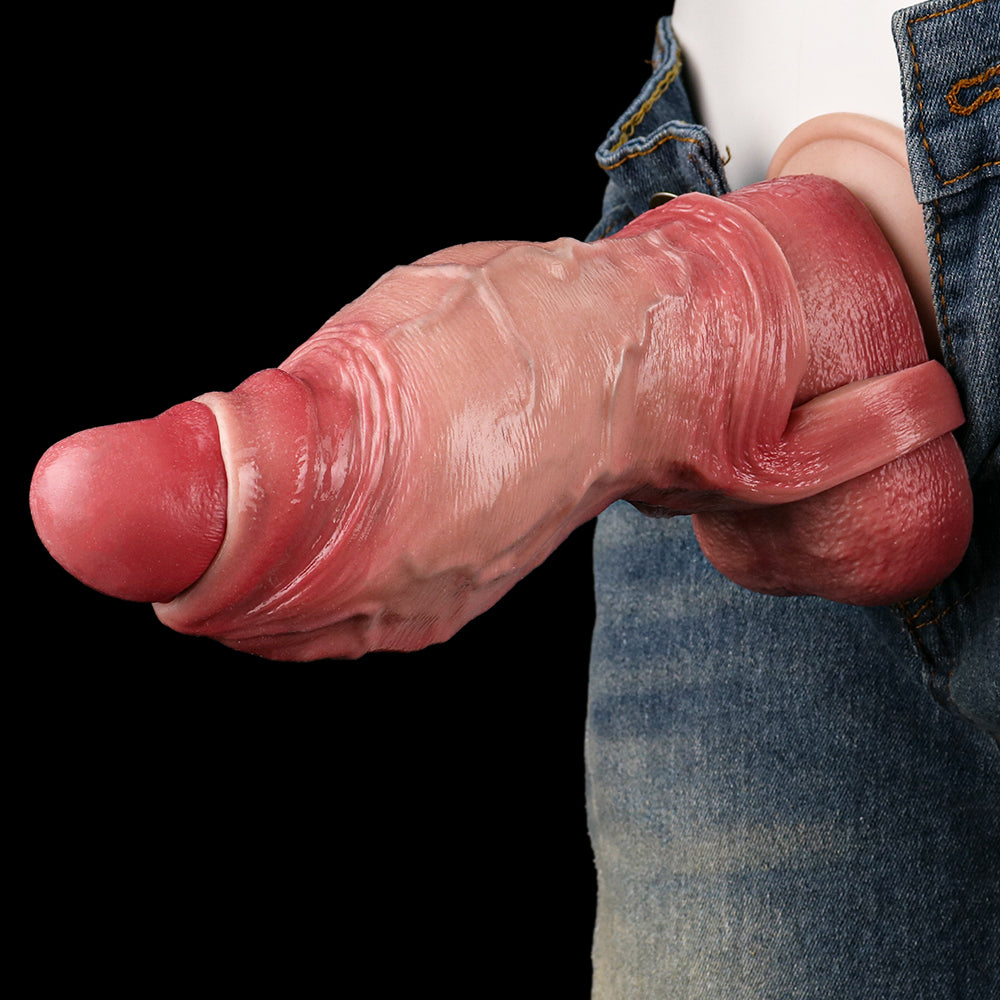
The upward penetration angle means that girth and texture engage the anterior wall on every stroke — not incidentally, but directly. In standard missionary, a cock sleeve adds girth that the receiving partner feels as fullness. In the butterfly, that same sleeve's texture is pressed against the G-spot or prostate on every stroke. The position amplifies what the sleeve delivers.

Platinum-cured silicone cock sleeve in the butterfly:
- Girth that the upward angle presses directly against the anterior wall — the receiving partner feels the width exactly where it matters
- Texture that engages the G-spot or prostate on every stroke — ridges and bumps that a smooth surface cannot provide at this angle
- Consistent shape throughout — platinum silicone does not deform under sustained thrusting the way TPE materials do
This is the Domlust material standard: platinum-cured silicone, non-porous, permanently stable. Not a premium feature — the minimum acceptable specification for a product used in penetrative sex.
For Partners with ED
The butterfly is one of the most ED-friendly positions available — for a specific mechanical reason that most guides miss.
In the standing configuration, the penetrating partner's hips are at a fixed height. They do not need to support their own body weight while maintaining an erection — which is one of the primary physical demands that makes ED more challenging in on-bed positions. The standing position allows the penetrating partner to focus entirely on hip movement rather than weight distribution and erection maintenance simultaneously.
The Low Butterfly variation (legs at 30 degrees) further reduces the depth requirement — which means a partial erection is sufficient to maintain penetration at this angle.

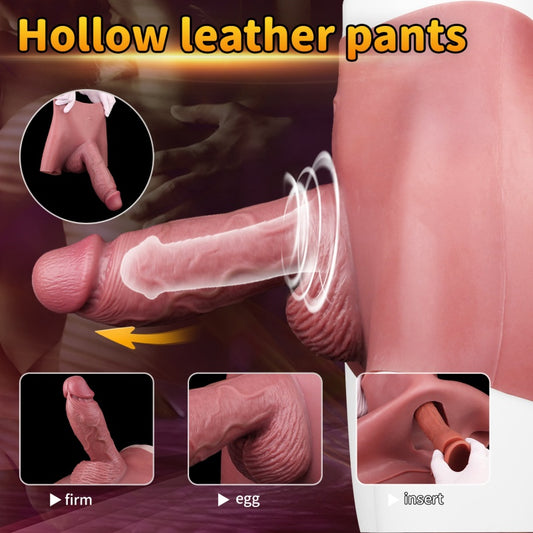
With a silicone penis sleeve pant, the butterfly becomes fully reliable regardless of erection level. The structured silicone holds shape and angle independently — the penetrating partner stands, positions, and thrusts; the sleeve maintains consistent girth and depth throughout. The upward angle means the sleeve's shape is pressed against the receiving partner's anterior wall on every stroke — which is the butterfly's defining sensation, fully preserved.
→ Full guide: ED & Sex — How Silicone Sleeve Pants Let You Take Back Control
For Gay Couples
The butterfly is one of the most underused positions for gay couples — and one of the most effective for prostate stimulation.
The upward penetration angle contacts the anterior rectal wall — where the prostate is — on every stroke. In standard doggy or missionary, the penetrating partner needs to angle upward deliberately to achieve this contact. In the butterfly, the geometry does it automatically.
For bottoms who have found that other positions produce inconsistent prostate stimulation, the butterfly's structural angle is often the solution — not more technique, just a different setup.
The standing configuration also gives the top full hip leverage without the coordination challenge of on-bed rear-entry positions. Depth control through hand position on the bottom's hips is more precise standing than kneeling.
→ Full Gay Sex Positions Guide: 9 Techniques Ranked by Prostate Intensity
Safety & Communication
Hip and lower back strain (receiving partner): The elevated hip position can create lower back strain over extended sessions. Use a wedge pillow rather than a standard pillow for longer sessions — the wedge maintains consistent elevation without the receiving partner needing to hold their position. Take breaks by lowering the legs to the bed surface.
Leg fatigue (receiving partner): Holding legs raised for extended periods creates hip flexor fatigue. Rest legs on the penetrating partner's shoulders or chest rather than holding them in the air — this transfers the support to the penetrating partner and removes the muscular demand from the receiving partner entirely.
Depth management: The upward angle can produce cervical contact (vaginal) or deep rectal contact (anal) that is uncomfortable for some receiving partners. Establish a clear signal before starting. The penetrating partner should reduce their forward lean immediately when signaled — small adjustments in standing position change depth significantly in this configuration.
Bed stability: The receiving partner's hips at the bed edge means the mattress edge bears their weight. Ensure the mattress is firm enough to support this without the receiving partner sliding off. A non-slip mat under the mattress or a dedicated sex furniture piece eliminates this concern.
Frequently Asked Questions
What is the butterfly sex position?
The butterfly is an edge-of-bed position where the receiving partner lies on their back with hips at the bed edge and legs raised, while the penetrating partner stands on the floor. The height difference creates an upward penetration angle that targets the G-spot or prostate directly — making it one of the most effective positions for anterior wall stimulation without requiring advanced flexibility from either partner.
Is the butterfly position good for G-spot stimulation?
Yes — it is one of the most reliable positions for G-spot stimulation because the upward angle contacts the anterior vaginal wall by default. Unlike missionary, where a pillow and specific technique are required to achieve this angle, the butterfly's edge-of-bed setup produces anterior wall contact on every stroke without additional adjustment. A cock sleeve with texture on the upper surface amplifies this significantly.
How is the butterfly different from missionary?
The critical difference is the penetrating partner's position: standing on the floor rather than lying on the bed. This creates a height difference that angles penetration upward toward the anterior wall, rather than horizontally as in standard missionary. The butterfly also gives the penetrating partner full standing leverage — more sustainable thrusting with better depth control — and removes the need to support their own body weight during the session.
Is the butterfly position good for beginners?
Yes — it is one of the most beginner-friendly positions for targeted internal stimulation. The setup is simple, the angle is effective without requiring technique, and the Low Butterfly variation (legs at 30 degrees) makes it accessible for receiving partners with limited hip flexibility. Start with the Classic variation (legs on chest) and adjust from there.
Can the butterfly position work with ED?
Yes — the standing configuration removes the need to support body weight while maintaining an erection, which reduces one of the primary physical demands that makes ED challenging in on-bed positions. The Low Butterfly variation further reduces depth requirements. A silicone penis sleeve pant removes the erection variable entirely — the structured silicone maintains shape and angle independently of the penetrating partner's physical state.
What toys work best with the butterfly position?
A platinum-cured silicone cock sleeve is the most effective enhancement — the upward angle presses the sleeve's texture directly against the G-spot or prostate on every stroke. A wedge pillow under the receiving partner's hips maintains consistent angle throughout the session. A vibrating ring provides passive clitoral stimulation without requiring repositioning. Water-based lubricant is essential — use more than you think you need.
What is the best bed height for the butterfly position?
Standard bed height (approximately 24–26 inches from floor to mattress surface) works for most couples when combined with a pillow under the receiving partner's hips. If your bed is lower, a thicker pillow or wedge compensates. If your bed is higher, the penetrating partner may need to stand on a small platform or the receiving partner's hips should be closer to the mattress surface. The goal is a 15–30 degree upward penetration angle.
What is "butterfly position sex" — is it different from the butterfly sex position?
No — butterfly position sex and the butterfly sex position refer to the same edge-of-bed configuration. The terminology varies by search phrasing, but the setup, mechanics, and benefits are identical: receiving partner at the bed edge with legs raised, penetrating partner standing on the floor, upward penetration angle targeting the anterior wall.
Is the butterfly sex position suitable for all couples?
The butterfly sex position works for virtually all couples — straight, gay, height-difference pairs, and partners managing ED. The Low Butterfly variation (legs at 30 degrees) makes it accessible for receiving partners with limited hip flexibility. The standing configuration accommodates height differences more naturally than any on-bed position. The only requirement is a bed or elevated surface at the correct height — approximately 24–26 inches from floor to mattress.
Related Positions
The butterfly sits in a specific part of the position spectrum — edge-of-bed setup, anterior-wall targeting, penetrating partner standing. These positions share elements of that profile:
- Apex Position — Similar anterior-wall angle achieved on the bed. More intimate, less leverage for the penetrating partner. The natural on-bed alternative to butterfly.
- Mating Press Position — Maximum anterior-wall contact with full-body compression. Higher intensity, more flexibility required. The advanced progression from butterfly.
- Full Nelson Position — Face-to-face deep penetration with arm control. Similar depth profile to High Butterfly, higher Dom/Sub intensity.
- Jackhammer Position — Maximum anterior-wall intensity. The advanced counterpart for couples who want to push beyond butterfly's angle.
- Best Sex Positions Guide — Complete reference with all positions ranked by intensity and control.
WHERE BUTTERFLY FITS — PROGRESSION PATH
Missionary → Butterfly → Apex → Mating Press → Full Nelson → Jackhammer
Butterfly is the first position where anterior-wall targeting happens structurally rather than through technique.