
Last updated: April 2026
Frotting (also called frottage or cock rubbing) is genital-to-genital sexual contact between partners — typically penis-to-penis for gay and bi male couples — where stimulation comes from friction, pressure, and skin contact rather than penetration. It is one of the oldest forms of male-male sexual expression, and for a significant portion of gay men, it is not a substitute for penetration but a preferred primary sexual practice in its own right.
QUICK SUMMARY
- What it is: Genital-to-genital friction — non-penetrative, full-body contact
- Also called: Frottage, cock rubbing, the Princeton Rub, intercrural sex
- Primary audience: Gay and bi male couples; anyone exploring non-penetrative intimacy
- Common misconception: That it's foreplay — for many gay men, it's the main event
- Key requirement: Generous lubrication — more than most guides suggest
- STI risk: Lower than penetrative sex, but not zero — HSV and HPV can transmit
Table of Contents
- What Frotting Actually Is — And What It Isn't
- Who Practices Frotting — The Real Picture
- The "Sides" Identity — The Gay Men Most Guides Ignore
- Why Frotting Feels Different From Penetration
- Techniques & Positions
- Lubrication — The Most Underestimated Variable
- Enhancement Options
- Frotting & ED — A Complete Practice, Not a Workaround
- Safety & STI Facts
- FAQ
- Related Guides
What Frotting Actually Is — And What It Isn't
Most frotting guides open with a definition and immediately pivot to safety tips — as if the primary thing to communicate is that frotting is acceptable and low-risk. That framing misses something important about why people actually search for this topic.
Frotting is genital-to-genital contact. For gay and bi male couples, this typically means penis-to-penis friction — both partners' genitals in contact, moving against each other. The stimulation comes from friction, pressure, warmth, and the specific sensation of another person's skin moving against yours in the most sensitive area of your body.
What it isn't: foreplay. Or at least, it doesn't have to be. The cultural assumption that "real" gay sex involves penetration — and that everything else is preparation for it — is a framework that many gay men have internalized without examining. A significant portion of gay men prefer frotting as their primary sexual practice. Not because penetration is unavailable or uncomfortable, but because frotting delivers something penetration doesn't.
Understanding this distinction changes what a useful frotting guide looks like. If frotting is foreplay, the guide should cover warm-up techniques. If frotting is a complete practice, the guide should cover everything a complete practice requires — technique, psychology, enhancement, and the specific reasons it produces the experience it does.
This guide takes the second approach.
Who Practices Frotting — The Real Picture
Frotting is most commonly discussed in gay male contexts, but the actual user picture is broader:
Gay and bi men as a primary practice: For many gay men, frotting is not an alternative to penetration — it is their preferred sexual practice. This group is underserved by most frotting guides, which are written from the assumption that the reader is curious about frotting as a supplement to penetrative sex.
Gay and bi men exploring their preferences: Many gay men have internalized the top/bottom binary without examining whether it reflects their actual preferences. Frotting is often where men discover that the binary doesn't apply to them — that what they want is mutuality, skin contact, and shared stimulation rather than the asymmetric dynamic of penetration.
Couples navigating penetration challenges: Pain, anxiety, ED, past trauma, or simply preference — there are many reasons a couple might choose non-penetrative sex. Frotting as a primary practice requires a different framing than "what to do when penetration doesn't work."
Straight and bi men exploring male-male intimacy: Men who are curious about physical intimacy with other men but are not interested in penetrative sex. Frotting is often the practice that fits this specific interest most accurately.
The "Sides" Identity — The Gay Men Most Guides Ignore
This section covers something that almost no mainstream sex guide addresses — because most guides are written from within the top/bottom framework without questioning it.
A 2020 study published in the Archives of Sexual Behavior found that approximately 15% of gay men identify as neither top nor bottom — preferring non-penetrative sex as their primary or exclusive sexual practice. This group has come to be called "sides" — a term that has gained significant traction in gay communities over the past several years.
For sides, frotting is not a workaround or a compromise. It is the practice that most accurately reflects their sexuality. The top/bottom binary that organizes most gay sex discourse — and most gay sex guides — simply does not apply to them.
What sides often report:
- Penetration is not appealing — not painful, not scary, just not what they want
- The mutuality of frotting is specifically what they find most satisfying — both partners experiencing the same type of stimulation simultaneously
- They have often felt invisible in gay sexual culture, which tends to organize itself around top/bottom dynamics
- Finding the language to describe their preference ("side") was itself a significant experience — it named something they had felt but couldn't articulate
If you identify as a side, or if you're exploring whether this term applies to you: frotting is not a lesser form of sex. It is a complete sexual practice with its own techniques, its own psychology, and its own specific pleasures. This guide is written for you as much as for anyone else.
Why Frotting Feels Different From Penetration
Most guides describe frotting as "more intimate" than penetration without explaining why. The reasons are specific and worth understanding — because understanding them lets you optimize for the experience you're looking for.
The Mutuality Factor
In penetrative sex, the roles are structurally asymmetric: one partner penetrates, one receives. Even in the most egalitarian dynamic, the physical experience is different for each person. In frotting, both partners experience the same type of stimulation simultaneously — friction, pressure, warmth — from the same contact point. There is no top and bottom in the structural sense.
This mutuality changes the psychological texture of the encounter. Both partners are doing the same thing to each other at the same time. The experience is shared in a way that penetrative sex structurally cannot replicate.
The Skin Contact Dimension
Full-body frotting — face-to-face, chest-to-chest, the entire front of both bodies in contact — activates a different sensory system than penetration. The skin contains C-tactile afferent nerve fibers that respond specifically to slow, gentle touch across large skin areas. These fibers connect directly to the brain's social bonding and reward systems — the same pathways activated by being held or skin-to-skin contact with someone you trust.
Penetration activates intense localized stimulation. Full-body frotting activates a broader, slower, more diffuse sensory experience. Many people describe this as more emotionally immersive — not more intense, but more total.
The Absence of Performance Pressure
Penetrative sex has a structural endpoint — penetration either happens or it doesn't, and the penetrating partner's physical state determines whether it does. Frotting has no such binary. There is no moment where the experience "fails" because of a physical variable.
This removes a specific type of anxiety that many men carry into penetrative sex without fully acknowledging it. Instead of monitoring physical state, both partners are present to sensation, rhythm, and each other.
The Symmetry of Vulnerability
In frotting, both partners are equally exposed — equally stimulated, equally present, equally without a defined role. For many men, this symmetry is specifically what makes frotting feel more intimate than penetration, where one partner is always more physically exposed than the other.
Techniques & Positions
1. Face-to-Face Grinding (The Princeton Rub)
Both partners face each other, bodies pressed together, genitals aligned and moving against each other. Full-body contact throughout — chest, stomach, thighs. The motion is grinding and rocking rather than thrusting.
This is the most intimate frotting configuration. The full-body skin contact activates the C-tactile nerve system described above, and eye contact throughout adds a psychological dimension that rear-facing configurations cannot replicate.
Technique: Align genitals deliberately before starting — this requires more intentional positioning than penetration. Apply lube to both partners' genitals before contact. Start slow — fast friction without adequate lubrication creates discomfort rather than pleasure. Build pace gradually as lubrication distributes and both partners warm up.
2. Side-by-Side (Spooning Frot)
Both partners lie on their sides, one behind the other, genitals in contact from behind. Less full-body contact than face-to-face, but more sustainable for longer sessions — neither partner is supporting weight, and the position can be maintained indefinitely without fatigue.
Good for slow, extended sessions where the goal is sustained intimacy rather than rapid escalation. Also the most accessible configuration for first-time frotting — the side-lying position is familiar and low-pressure.
3. Intercrural (Thigh Frotting)
One partner's penis moves between the other partner's closed thighs. The thighs create pressure and friction on the shaft; the partner whose thighs are being used feels pressure and warmth from the inside.
This configuration has a long history in gay male sexuality — it was one of the primary non-penetrative practices in cultures and periods where anal penetration was culturally or legally restricted. It produces a different sensation from face-to-face frotting — more focused, less full-body — and is often preferred by men who want more concentrated shaft stimulation.
Technique: Receiving partner closes thighs firmly. Generous lubrication on both the penis and the inner thighs is essential — without it, thigh friction creates skin irritation rather than pleasure. The active partner uses a sliding motion rather than thrusting. The receiving partner can squeeze their thighs to adjust pressure in real time.
4. Hand-Guided Frotting
One or both partners use their hands to hold both penises together, creating a combined stimulation surface. This gives precise control over pressure and alignment, and allows one partner to take a more active role in guiding the experience.
Often used as a transition between other frotting configurations, or as the primary technique for couples who prefer more controlled, deliberate stimulation over full-body grinding.
5. Standing Frotting
Both partners stand facing each other. Height similarity matters more here than in lying-down configurations — a significant height difference makes genital alignment difficult without adjustment. Standing frotting allows full freedom of movement for both partners and is often used in shower or bathroom contexts where lying down is not practical.
Lubrication — The Most Underestimated Variable
Every frotting guide mentions lubrication. Most treat it as a footnote. It isn't — it is the single variable that most determines whether frotting feels good or uncomfortable.
Frotting involves sustained skin-to-skin friction on some of the most sensitive tissue on the body. Without adequate lubrication, this friction creates irritation, micro-abrasions, and discomfort that overrides the pleasure of the practice. The most common reason people try frotting and find it unsatisfying is insufficient lubrication — not technique, not position, not compatibility.
Water-based lubricant is the correct choice for most frotting contexts — it distributes evenly, reactivates with water or saliva, and is safe with all toy materials including platinum silicone. Apply generously to both partners' genitals before contact, and reapply whenever friction starts to feel like resistance rather than glide.
Silicone-based lubricant lasts longer and requires less reapplication — appropriate for frotting without toys. If you are using any platinum silicone products, use water-based only to avoid degrading the silicone surface.
How much is enough: More than you think. The correct amount of lubrication for frotting is the amount that makes the friction feel like gliding rather than rubbing. If you can feel skin catching on skin, you need more.
Enhancement Options
Frotting works without any additional tools — but the right additions change the sensory texture of the experience in specific ways.
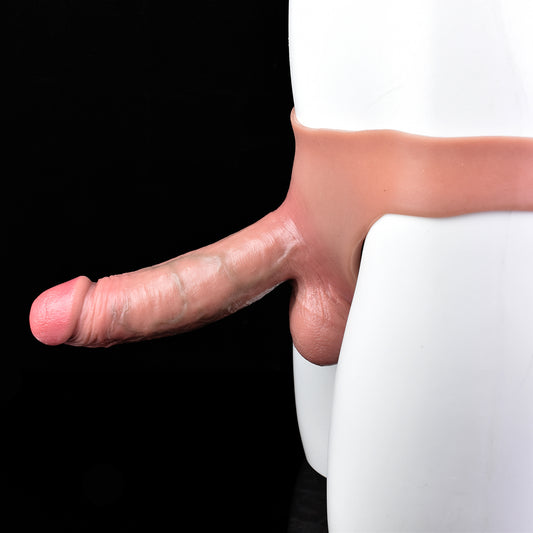
Cock sleeve (open-ended): Worn by one partner, a textured silicone sleeve changes what the other partner feels during genital contact — the texture of the sleeve surface rather than skin. This creates sensation asymmetry: one partner feels smooth skin, the other feels textured silicone. Some couples find this contrast specifically interesting; others prefer the symmetry of skin-to-skin contact.
Vibrating ring: Worn by one partner at the base of the penis, vibration transfers to both partners during genital contact. Adds a stimulation layer without changing the fundamental dynamic of the practice.
Realistic pussy panties: For couples exploring cross-sensation — one partner wears the panties, the other frots against the realistic silicone surface. The result is vaginal texture during non-penetrative genital contact. This is a niche application, but for gay couples curious about this specific sensation without penetration, platinum silicone pussy panties are the only product that delivers it safely — TPE alternatives off-gas against the sensitive skin they're worn against.
Frotting & ED — A Complete Practice, Not a Workaround
Most ED-related sex advice treats non-penetrative sex as a consolation prize — "things you can do when penetration doesn't work." This framing is both inaccurate and unhelpful, and it shapes how couples approach frotting in ways that undermine the experience before it starts.
If you approach frotting as "what we do when penetration fails," you bring the failure framework with you. The session starts with an implicit acknowledgment of what isn't happening rather than full attention to what is.
Frotting as a deliberate primary practice — chosen, not defaulted to — is a different psychological setup entirely. "We're going to frot tonight" removes the performance variable from the equation. There is no threshold to meet, no binary of success or failure. Both partners are stimulated by the same contact; the quality of that contact determines the experience.
For couples where ED has created avoidance — where the anticipation of potential failure has led to reduced sexual frequency — this reframing can break the pattern. The practice itself is the goal. There is nothing to fail at.
This is not a workaround. It is a complete sexual practice that happens to remove the variable that ED introduces into penetrative sex. The distinction matters psychologically — for both partners.
→ Full guide: ED & Sex — How Silicone Sleeve Pants Let You Take Back Control
Safety & STI Facts
Frotting carries significantly lower STI transmission risk than penetrative sex. Understanding the specific risks — rather than treating frotting as either "completely safe" or "risky like penetration" — allows for accurate risk assessment.
What can transmit through frotting:
- Herpes (HSV-1 and HSV-2) — transmits through skin-to-skin genital contact without penetration. If either partner has active sores or is in a prodromal phase, avoid skin contact in the affected area.
- HPV — transmits through genital skin contact. Vaccination (Gardasil) provides protection against the most common strains.
- Syphilis — can transmit if sores (chancres) are present on the skin surface in the contact area.
What does not transmit through external frotting (without fluid exchange or penetration):
- HIV — transmission through frotting alone is considered negligible risk by current medical consensus. HIV requires mucosal contact or direct bloodstream exposure.
- Gonorrhea and chlamydia — require mucosal contact and are not transmitted through external skin friction.
Practical approach: Regular STI testing remains appropriate for sexually active people regardless of practice. Condoms reduce transmission risk for skin-contact STIs if desired. The HPV vaccine is recommended for all sexually active adults under 45 who have not previously been vaccinated.
Frequently Asked Questions
What is frotting?
Frotting is genital-to-genital sexual contact — typically penis-to-penis for gay and bi male couples — where stimulation comes from friction, pressure, and skin contact rather than penetration. It is a complete sexual practice in its own right, not a foreplay technique or penetration substitute. For a significant portion of gay men, frotting is their preferred primary sexual practice.
What is the difference between frotting and frottage?
Frottage is the broader term for any sexual rubbing or friction — it can refer to clothed rubbing, body-to-body contact, or genital contact. Frotting specifically refers to penis-to-penis genital contact between male partners. In practice, the terms are often used interchangeably in gay male contexts.
Can you orgasm through frotting alone?
Yes — many men orgasm through frotting regularly. The frenulum and glans are the most sensitive areas of the penis, and sustained friction against these areas with adequate lubrication produces orgasm for most men. The time required varies by individual, lubrication quality, and technique — but frotting is a complete sexual practice capable of producing orgasm without any other stimulation.
What is a "side" in gay sexual identity?
A "side" is a gay or bi man who prefers non-penetrative sex — neither topping nor bottoming. The term emerged from gay communities to name an experience that many men had but lacked language for. A 2020 study in the Archives of Sexual Behavior found approximately 15% of gay men identify this way. For sides, frotting is not an alternative to penetration — it is their primary sexual expression.
Is frotting safer than anal sex?
Yes, significantly — but not risk-free. Frotting carries negligible HIV transmission risk and no gonorrhea or chlamydia risk through external contact alone. However, herpes (HSV), HPV, and syphilis can transmit through skin-to-skin genital contact. Regular STI testing remains appropriate regardless of sexual practice.
What is the Princeton Rub?
The Princeton Rub is a colloquial term for face-to-face frotting — both partners pressed together, genitals in contact, grinding against each other. The name originated as a euphemism in American college culture. It is one of the most common frotting configurations and the one most associated with full-body intimacy.
How does frotting work for couples with ED?
Frotting removes the performance threshold that makes ED psychologically difficult. There is no binary of penetration achieved or not achieved — both partners are stimulated by the same contact, and the quality of that contact determines the experience. Approaching frotting as a deliberate primary practice (not a fallback) breaks the avoidance pattern that ED often creates in couples.
Related Guides
- Gay Sex Positions: 9 Techniques Ranked by Prostate Intensity — For couples who want to explore both frotting and penetrative positions within the same framework.
- ED & Sex: How Silicone Sleeve Pants Let You Take Back Control — Full framework for navigating ED, including frotting as a primary practice.
- Best Sex Positions: Complete Guide — Full position reference including non-penetrative options.