


Domlust
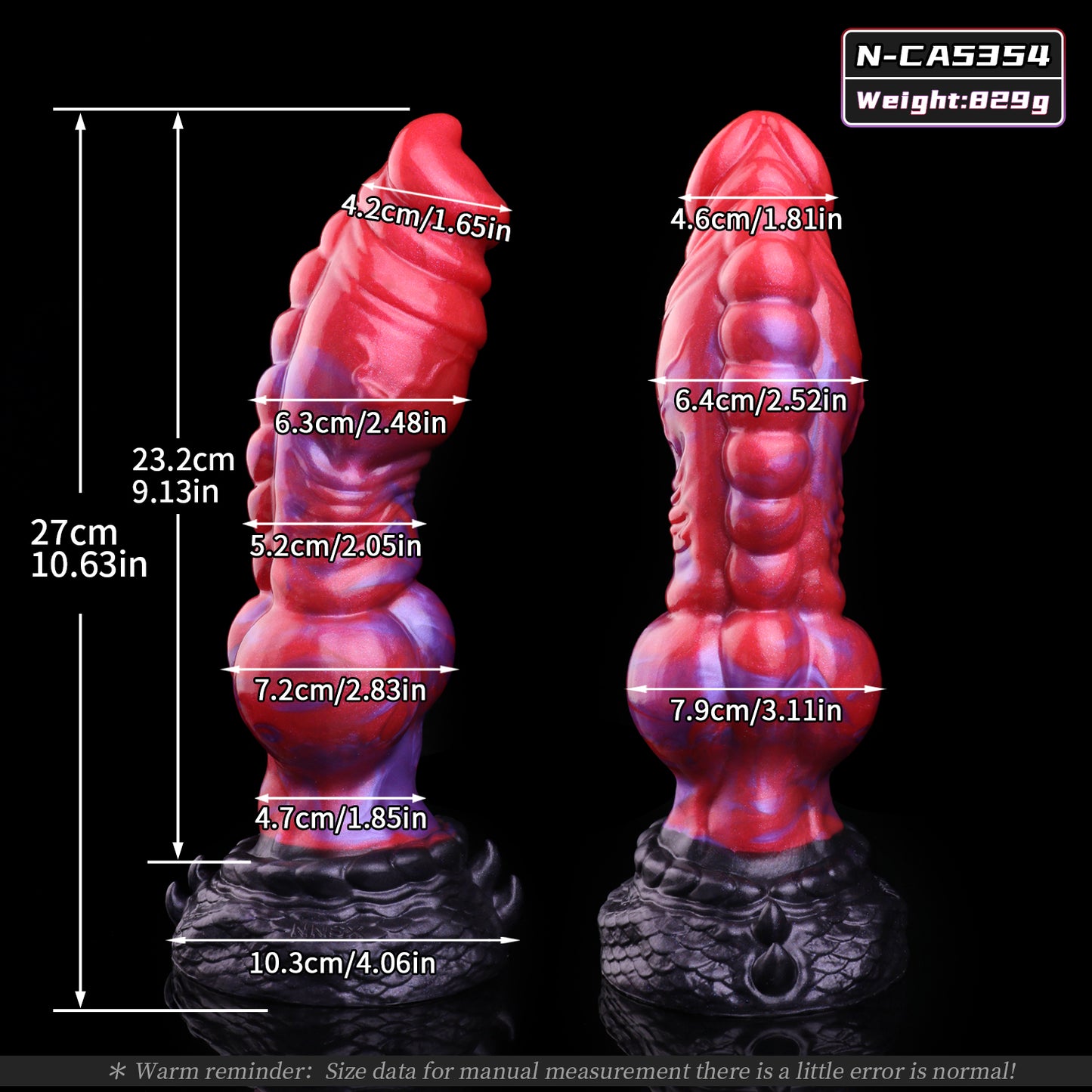
Crimson Coil — Fantasy Dog Dildo in Platinum Silicone, Red-Violet Pearl Marble, Segmented Glans, Ball-Row Shaft & Scale-Carved Suction Base
Crimson Coil — Fantasy Dog Dildo in Platinum Silicone, Red-Violet Pearl Marble, Segmented Glans, Ball-Row Shaft & Scale-Carved Suction Base
Couldn't load pickup availability
Crimson Coil — Every Centimetre Counts: A Fantasy Dog Dildo Built for Texture-First Users
THREE ZONES. ONE PIECE.
This is a dog dildo built around a specific principle: texture at every depth. The tip engages with a segmented coil form. The mid-shaft delivers twin columns of raised ball rows. The base zone resolves into a stacked multi-ball knot. Below everything, a scale-carved void-black platinum silicone suction base.

The Domlust Crimson Coil is cast in red-violet pearl marble platinum silicone — a jewel-tone large-patch pour where deep crimson dominates the tip and upper shaft, and rich grape-violet claims the ball knot and lower zones. Every surface zone is distinct. No two centimetres of this shaft feel the same.
ZONE 1 — THE SEGMENTED GLANS
The tip is a coil-form segmented glans: a small rounded apex at the very top, followed by three to four lateral ring segments, each separated by a visible horizontal constriction groove. The segments stack in a slightly spiral arrangement, creating a corkscrew visual profile at the tip.
In use, the ring segments engage the entry tissue sequentially as the tip advances — each constriction groove creates a brief pressure reduction between segments, and each ring edge creates a defined circumferential contact event. The tip does not feel like a standard rounded glans; the sequential ring engagement produces a pulsing, rhythmic sensation at the entry point during insertion.
ZONE 2 — THE TWIN BALL-ROW SHAFT
Below the glans, the shaft carries two bilateral columns of raised ball forms — round, dome-shaped convex nodules arranged in vertical rows running the length of the shaft, one column on each lateral face. Each ball in the column is a full dome, separated from the next by a short smooth bridge.

The twin-column arrangement creates two distinct high-contact faces (the ball-row faces) and two low-contact faces (the smooth groove faces between the columns). Orientation during use determines which face contacts which tissue surface. The ball rows create sequential dome-press contact as the shaft moves — each ball a distinct pressure event, with the smooth bridge providing momentary release before the next ball engages. Colour: full crimson-to-violet pearl marble, crimson dominant in the upper section, purple increasingly dominant toward the knot zone.
ZONE 3 — THE STACKED MULTI-BALL KNOT

The base section is a stacked cluster of three to four large smooth ball forms — each ball larger than the shaft above it, creating a graduated girth staircase that resolves into the maximum-girth point. Unlike a single knot, each ball in the stack is a discrete girth event. The lower zone is the most violet-dominant section — deep grape-purple pearl, shifting to red-violet at the junction points between balls. The stacked balls function as: a texture zone in their own right, a graduated girth escalator toward maximum depth, and the depth stop that prevents over-insertion.
THE SCALE-CARVED BASE

The base is void-black platinum silicone, covered entirely in a tight hexagonal scale texture — each scale cell individually defined, creating a dense reptile-skin or dragon-scale visual across the full base exterior. Large flat circular suction disc on the underside. The scale carving creates a grippable exterior surface for manual use. The base is visually and materially distinct from the shaft — a deliberate contrast between the jewel-toned marble above and the void-black scale below.
QUICK REFERENCE
| Feature | Detail |
|---|---|
| Material | Platinum-cured liquid silicone |
| Tip | Segmented coil glans · 3–4 ring segments · Spiral stack |
| Tip Colour | Pure saturated crimson · Pearl sheen |
| Shaft Texture | Twin bilateral ball-row columns · Dome nodules |
| Shaft Colour | Crimson-violet pearl marble · Crimson-dominant upper |
| Knot | Stacked 3–4 ball cluster · Graduated girth · Smooth surface |
| Knot Colour | Deep grape-violet pearl · Violet dominant |
| Base | Void-black · Hexagonal scale carving · Suction disc |
| Body Safe | Non-toxic · Non-porous · Hypoallergenic · Phthalate-free |
| Waterproof | Full body |
| Lubricant | Water-based only |
QUESTIONS OWNERS ASK
“The segmented glans looks completely different from a standard dildo tip — how does the sequential ring contact actually feel during a full insertion stroke?”
The ring segments engage tissue in sequence during insertion, but because the glans is narrower than the shaft behind it, the ring segment sensation occurs specifically at the entry point as the tip advances. What changes during a full stroke is the moment of re-entry on each out-and-in cycle: each time the tip re-enters, the ring segments pass through the entry point again in sequence — making the tip sensation a repeating rhythmic event rather than a one-time experience. The spacing between ring segments determines the rhythm: closer rings produce a faster pulse per centimetre of movement; wider rings produce a slower, more distinct step-form. On withdrawal, the rings pass back in reverse order. Most users notice the ring segments most clearly at low speed and partial depth, where the glans is the primary contact zone — at full depth, shaft texture dominates.
“Two ball columns on one shaft — how do I know which orientation to use, and does it actually matter?”
The twin ball columns are on opposing lateral faces — left and right when viewing the toy from the front. Between them, on the front and back faces, the shaft surface is smoother. This creates two distinct texture profiles: high-contact (ball rows toward tissue) and low-contact (smooth grooves toward tissue). Orienting ball columns toward the anterior and posterior walls gives both surfaces simultaneous ball-row contact — maximum texture engagement on both. Orienting ball columns toward the lateral walls gives anterior and posterior surfaces the smooth groove faces instead. For most users, the anterior wall (G-spot zone) is more sensitive — orienting one ball column toward the anterior wall while the other faces a less sensitive zone is a common preference for targeted stimulation. A quarter-turn rotation during use is the most effective way to find the orientation that works best for your anatomy.
“The stacked multi-ball knot looks much larger than the shaft — is there a way to enjoy the shaft texture without committing to the full knot girth?”
Yes. The shaft and knot are separate use zones — the stacked ball section is only engaged if you insert to the depth where the first ball reaches the entry point. For the majority of the shaft’s usable length, the twin ball columns and segmented glans are the active texture zones, and the stacked knot remains outside the body as a physical depth stop. Users can approach the stacked section incrementally — engaging the first ball on its own before attempting deeper knot engagement. Each ball in the stack is a discrete girth event that can be approached individually. Users experienced with knotted fantasy dildos typically approach the stacked section deliberately and slowly, with full lubrication, over multiple sessions.
“The scale-carved base looks decorative — is it actually functional as a grip surface during manual use?”
The hexagonal scale texture covers the full base exterior. During manual use, the scale cells create purchase points for fingertip contact that smooth silicone cannot. The improvement is most noticeable with wet hands, lubrication transfer from shaft to base, or extended sessions where grip pressure varies. The scale cells are small enough that the texture reads as a fine, even surface grip rather than a coarse one. For full-hand grip around the base, the scale texture distributes palm contact across more surface area than smooth silicone, reducing localised pressure over extended use. The suction disc underside is smooth and does not interfere with grip when holding from the base exterior.
“I want to use this toy in the shower — what’s the realistic suction performance on wet tiles compared to dry surfaces?”
On dry smooth tile, the disc creates maximum vacuum and strongest hold. On wet tile, a water film between disc and surface acts as a lubricant that reduces static friction — the toy may slide under lateral force even when vertical suction hold remains intact. The approach for shower use: press the disc firmly onto the tile and twist to expel the water film, then apply downward pressure to maximise seal. Test with a firm lateral push before use. Re-press and re-seal if hold reduces during use. Smooth glazed wall tile is consistently the best suction surface in showers — grout lines, textured anti-slip floors, and porous surfaces will not seal reliably.
“This toy has more surface features than most — does cleaning between all the ball rows and scale carvings require special tools?”
All surface features are cast in the same non-porous platinum silicone — they do not absorb fluids or bacteria. Standard cleaning does not require special tools: warm water and a toy cleaner or unscented soap applied with the hands, worked into the ball-row channels and ring segment grooves, then rinsed thoroughly under running water. For more thorough cleaning, a soft-bristle brush (dedicated toy brush or reserved soft toothbrush) can reach the base scale cells without damaging the silicone. Do not use silicone-based lubricants — they degrade the silicone surface over time. Allow to air dry fully before storage — trapped moisture in the ball-row channels or scale cells is the primary hygiene risk.


Fresh Releases for Your Desires
-
Void Spine — Full-Coverage Textured Fantasy Dog Dildo in Platinum Silicone, Purple-Crimson Pearl Marble, Ringed Spine Shaft & Testicle Suction Base
Regular price $128.20 USDRegular priceUnit price per -
Crimson Coil — Fantasy Dog Dildo in Platinum Silicone, Red-Violet Pearl Marble, Segmented Glans, Ball-Row Shaft & Scale-Carved Suction Base
Regular price $98.20 USDRegular priceUnit price per -
Scarlet Fang — Fantasy Dog Dildo in Platinum Silicone, Crimson-Violet Cloud Marble, Four-Nub Glans & Fur-Textured Suction Base
Regular price $92.80 USDRegular priceUnit price per -
Void Hound — Fantasy Dog Dildo in Platinum Silicone, Electric Red-Violet Marble, Vein Texture, Nodule Clusters & Snarling Beast Base
Regular price $95.80 USDRegular priceUnit price per -
Inferno Drake — Fantasy Dragon Dog Dildo in Platinum Silicone, Red-Violet Marble, Dorsal Spine Barbs & Sculpted Base
Regular price $107.80 USDRegular priceUnit price per -
Crimson Beast — Fantasy Dog Dildo in Platinum Silicone, Red-Purple Marble, Barbed Shaft, Knot & Suction Base
Regular price $119.20 USDRegular priceUnit price per -
Crimson Tide — Marbled Red-Purple Tentacle Long Dildo, Platinum Silicone, Full-Shaft Sucker Rows & Sculpted Octopus Base
Regular price $134.20 USDRegular priceUnit price per -
Pocket Dragon Sex Toy — Platinum Silicone, Blue Fantasy Beast, Textured Pink Shaft & Internal Stimulation Channel
Regular price $160.60 USDRegular priceUnit price per -
Large-Ball Squirting Dildo — Platinum Silicone, Coral-Rose Testicles, Full-Shaft Vein Texture & 3-Tool Ejaculation
Regular price $80.20 USDRegular priceUnit price per -
Flesh-Tone Squirting Dildo — Platinum Silicone, Heavy Skin-Fold Base, Fine Red Vein Detail & 3-Tool Ejaculation
Regular price $79.80 USDRegular priceUnit price per


Don’t Miss Our Best-Selling Favorites
-
21 Inch Tentacle Dildo with Endoscope Camera - Extra Long Silicone Alien Toy for Deep G-Spot Exploration
Regular price $156.20 USDRegular priceUnit price per$176.20 USDSale price $156.20 USDSale -
Serpent Queen Alien Sex Doll - Platinum Silicone Full-Body for Men Masterbating Who Crave Fetish Intimacy
Regular price $278.80 USDRegular priceUnit price per$298.80 USDSale price $278.80 USDSale -
Thick Dildo Penissleeve Extender Pants – High Waist Silicone Realistic Cock Sleeve Sheath Underwear
Regular price $158.80 USDRegular priceUnit price per$158.80 USDSale price $158.80 USD -
White Dragon Torso Pocket Pussy – Fantasy Oral Silicone Masturbator | Domlust Fetish
Regular price $126.60 USDRegular priceUnit price per$146.60 USDSale price $126.60 USDSale


